Compliance
Operational compliance workflows · Web UI · API · MCP
Compliance Platform
Trade and sanctions screening with evidence.
CN / TARIC
Sanctions lists
Screening Cases
ISO 20022 payments
API + MCP
Not affiliated with the European Commission. Does not replace official sources or decisions by competent authorities.
v7 · September 2026
02 · The challenge
The hard part isn't the screening. It's defending the result.
Compliance work fails when an answer can't be reproduced, sourced, or explained to an auditor.
- Sanctions lists, TARIC measures, and entity registers live across dozens of regulators. Combining them by hand burns reviewer time.
- Most tools give a yes/no result. Auditors want the source link, the timestamp, and the reviewer's reasoning.
- Aliases, transliterations, and local-name variants turn a clean "no match" today into a missed match tomorrow.
- TARIC checks, entity screenings, and vessel verifications accumulate across spreadsheets and email — not as a single auditable case.
- When a tool flags a match, reviewers can't always see why. That makes the decision hard to defend under audit.
- Engineers building internal automation are usually stuck scraping the same UI that compliance teams use.
Audit-defense gap
1
Many official sources
Sanctions lists, TARIC measures, entity registers
2
Manual combination
Spreadsheets, screenshots, email threads
?
Decision under audit
"Where is the evidence?"
A defensible result keeps data, source, parameters, reviewer, and timing together.
03 · Target audience + positioning
Compliance tooling was built for Tier 1 banks. Compliance work happens everywhere else.
The same regulatory exposure now reaches teams without enterprise compliance departments.
- Compliance tooling emerged after 9/11 and matured inside banks and Big Four consultancies. It still costs and configures like it.
- Same regulatory pressure, much wider field: multinational corporates, regional and SMB banks, logistics firms, customs brokers, regional airports, police task forces, notaries, and community services.
- These teams don't have a dedicated compliance department. The work falls to operations, legal, or the GM — done alongside their day job.
- They need defensible screening evidence just as much as a Tier 1 bank does — but can't justify a six-figure license or six-month integration.
- They need it accessible from where they work: a web tool the lawyer uses, an API the engineer integrates, an MCP server the AI agent calls.
- The compliance long tail is orders of magnitude larger than the bank/Big Four core — same regulatory exposure, far less tooling, no serious incumbent serving them.
The compliance long tail
Bank / Big Four core
Multinational corporates
Regional & SMB banks
Logistics firms
Customs brokers
Regional airports
Police task forces
Notaries
Community services
Same pressure. Far less tooling. No serious incumbent serving the full breadth.
04 · Main functionalities
Defensible compliance, without an enterprise compliance team.
The platform turns daily screening operations into evidence-ready decisions.
- Get a single source-linked answer to "is this OK to ship, process, or transact?" — across TARIC/CN measures, sanctions, and entity registers, not three separate tools.
- Produce defensible evidence as a side effect of the work. Every saved check is timestamped, source-linked, and reviewer-tagged automatically — no separate audit-prep ritual.
- Catch what manual review misses. Alias matching, transliteration variants, and local-name patterns surface candidates a yes/no scan would skip.
- Start from the register, not from a name. Pull a company from supported Latvian, Estonian, Polish, or Kazakh register data. Where the official record exposes officers or owners, add those related parties to screening.
- Produce defensible evidence as part of the workflow. Saved cases keep timestamps, source links, parameters, results, and reviewer context together.
- Start in the workspace today. No six-figure floor, no six-month integration, no compliance department prerequisite.
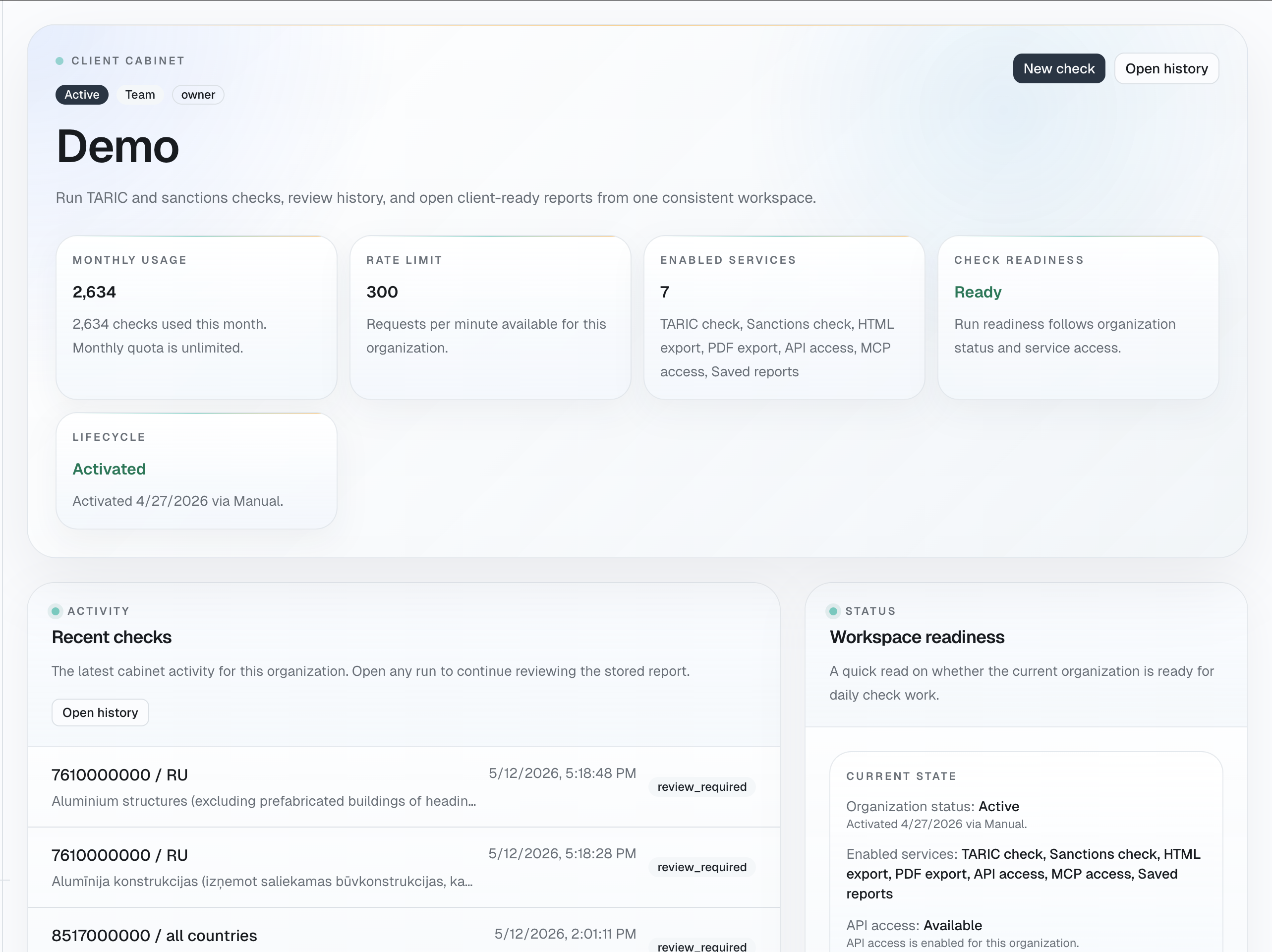
Workspace status, enabled services, readiness, and recent checks in one consistent view.
05 · Channels
Three surfaces, one source of truth.
Reviewer, engineer, and AI agent use the same data underneath.
- Web UI — the full screening surface for direct reviewer use. Same data, same evidence, same audit trail as the other channels.
- API — REST endpoints for supported integration workflows. The channel is a paid add-on on self-service plans and included with Enterprise.
- MCP Server — exposes screening workflows as native tools for AI agents. Any MCP-capable client (Claude, ChatGPT Agents, custom) can call checks and receive source-linked evidence.
- One audit trail when persisted. Web, API, and MCP can create the same Screening Case artefact; quick one-shot checks remain transient by design.
- Shared core. All three channels use the same core screening and source catalogue. Entitlements, persistence and output remain specific to each channel.
- Entitlements are explicit. MCP is included within each plan's limits; REST API access is an optional paid add-on, or included with Enterprise.
Ecosystem
REST API
Internal automation
Same data
Sanctions · TARIC · close-match
One audit trail
Screening Cases register
Shared core screening; saved checks use the common case artefact.
06 · TARIC / CN code checks
One query, every applicable measure, source-linked.
Date-aware checks preserve the inputs that produced the result.
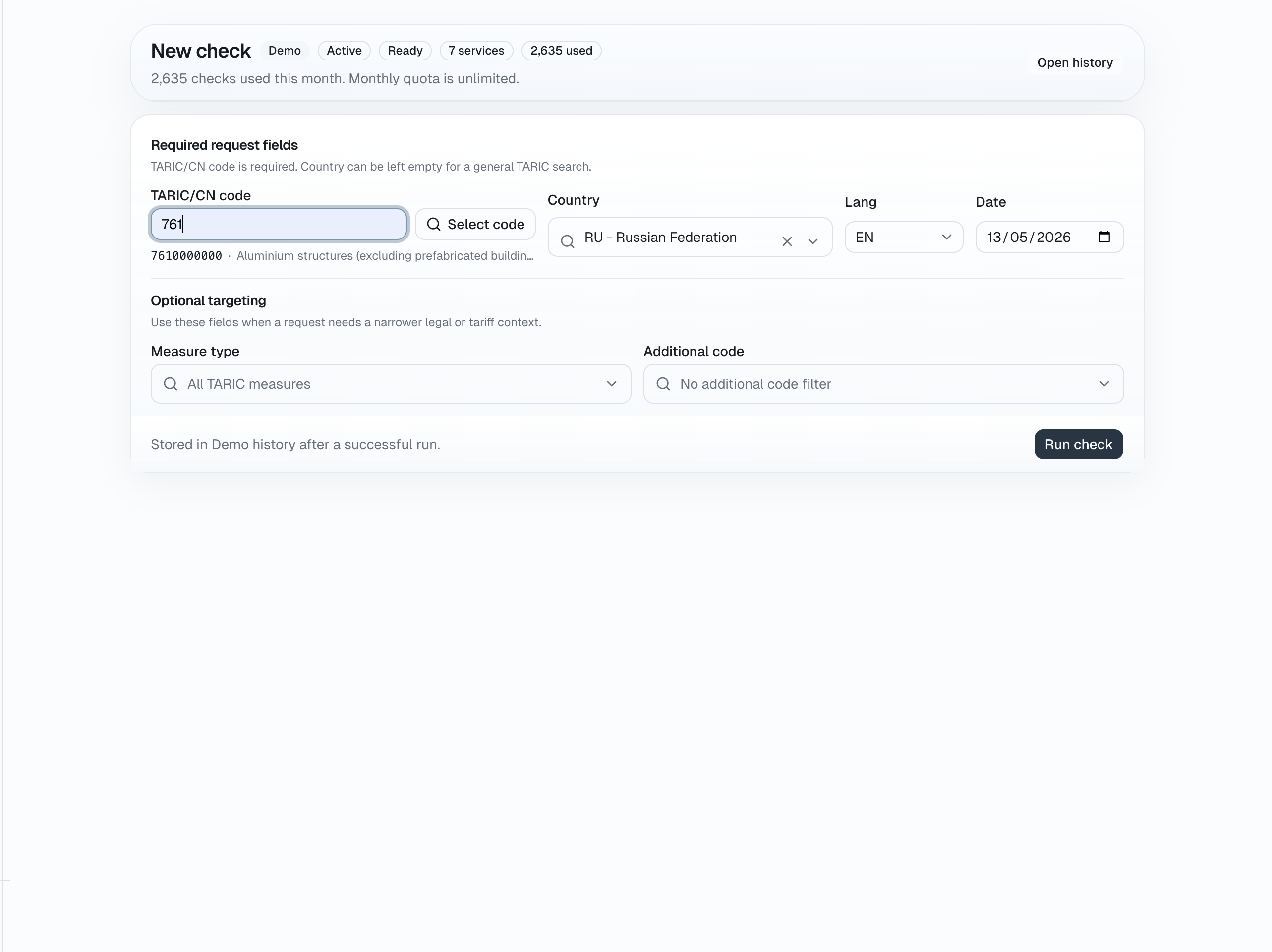
- Input what a customs declaration needs: the CN/TARIC code, the destination country, the relevant date. Optional narrowing — measure type, additional codes.
- Get back two layers in one report: a sanctions annex callout when applicable, plus the full TARIC measure picture — tariff suspensions, import/export controls, prohibitions, origin-specific rules — each with regulation reference, date range, and inline condition definitions.
- Every measure links back to its source — the underlying EU regulation or TARIC database entry. The report shows reviewers (and auditors) the reasoning, not just the verdict.
- Date-aware queries. Reproduce a check as of any prior date. Defend a past decision with the exact regulatory state that applied at the time.
- Saved parameters travel with results. The inputs that produced a check are preserved alongside the output. No "what did I search for?" gaps in the audit trail.
- A whole declaration at once. Check every line of a customs declaration in one run instead of code by code, and get a single justification report covering all of them.
Date-aware
Saved parameters
07 · Goods classifications · EBTI
Find a customs code from the product description
CN / TARIC · Web + MCP
Describe the goods, materials and use. Compare official EBTI decisions, clarify differences and select an active CN/TARIC code for the goods check.
One credit covers one product and up to three successful searches in the same classification. Empty searches and errors consume no classification credit. Search permits at most 6 attempts in total, including empty results and errors.
Prepaid classifications
€5 / 100 classifications
Excluding VAT. Choose the number of 100-credit packs: 3 packs cost €15 and add 300 classifications. This balance is separate from screening cases and API calls.
Buying and spending prepaid credits requires an active paid plan or contract. Free cannot buy or spend them. Resume a paid subscription to use a retained balance.
Free: 5 for the entire Free term. Starter: 25/month; Team: 100; Professional: 300; Business: 1,000. Enterprise: contractual allowance. Paid allowances reset each calendar month UTC.
Compliance Platform · EBTI
07 / 16
08 · Sanctions screening
150+ official sources. Every result tied to evidence.
Official sanctions sources are browsable and linked back to the originating record.
- What gets screened. Names — people, companies, vessels, aircraft — together with aliases, local-name variants, transliterations, dates of birth, and identifiers (passport, IMO, BIC, registration numbers).
- What it's screened against. A catalogue of 150+ official sources across sanctions, PEP/EDD, debarment, export control, maritime risk, regulatory watchlists, business registers, and customs reference.
- Match logic catches what manual review misses. Aliases, transliterations, phonetic equivalents, and local-name patterns are evaluated alongside exact matches. Threshold is configurable per check.
- Every match comes with its source. Each hit links back to the originating list entry — list name, programme, regulation reference, listing grounds. The reviewer sees evidence, not just a verdict.
- Goods-level sanctions, too. The same workflow checks CN/TARIC codes against goods-restricting annexes (e.g., RU Reg. 833/2014 ANNEX XXIII), so an entity check and a goods check land in the same case.
- Browse the structured dataset directly. The Reference Library surfaces the listed-entities table — filter by programme, type, country, or source when verifying a source record outside an active screening run.
Data coverage · 14 examples from the 150+ catalogue
| Official source | Authority |
|---|
| OFAC SDN | United States |
| EU FSF | European Union |
| EU Russia (Reg. 833/2014) | European Union |
| EU Belarus (Reg. 765/2006) | European Union |
| UN SC Consolidated | United Nations |
| UK Sanctions List | United Kingdom |
| CH SECO | Switzerland |
| JP MOF | Japan |
| AU DFAT | Australia |
| CA SEMA | Canada |
| LV FID | Latvia |
| LV FID frozen-assets | Latvia |
| PL MSWiA | Poland |
| UA NSDC | Ukraine |
Each workflow selects the relevant source profile. Refresh cadence and freshness evidence follow the official publisher.
09 · ISO 20022 payment screening
Pre-flight screening for pain.001 and pacs.008.
The parser extracts the parties present in the message; a persisted case keeps the raw payload and evidence.
- Full-message parsing. pain.001 and pacs.008 XML is parsed as supplied. When a PaymentCase is created, the raw XML, SHA-256 hash, message metadata, and warnings are stored with it.
- Validation is explicit. Structural checks always run. XSD status is recorded as valid, invalid, or not configured; an invalid configured schema produces an integrity error.
- Role-aware participants. Banks, debtor, creditor, and any intermediary agents present in the XML are extracted independently. Missing required roles become warnings.
- Policy-based source selection. Each participant is screened using the source profile selected for the case — not an unconditional scan of every catalogue source.
- BIC resolution is evidence-led. Configured resolvers can add legal-name context. Unresolved identifiers and name conflicts remain visible rather than being silently inferred.
- Choose persistence. A quick screening run is transient; creating a PaymentCase stores participant results and the message evidence for review.
Brand promise · case-as-audit
The hard part isn't the screening. It's defending the result.
A persisted PaymentCase keeps the source XML hash, validation state, extracted participants, selected policy, and screening evidence together.
The audit trail is created when the workflow is saved as a case; one-shot runs are intentionally separate and time-limited.
10 · ISO 20022 participant roles
Six role classes are recognized. Only parties present are screened.
pain.001 and pacs.008 expose different chains; each extracted participant is evaluated independently.
| # |
Role |
pain.001 mapping |
pacs.008 mapping |
Entity |
What gets screened |
| 1 |
Sender Bank |
DbtrAgt (implied initiation) |
InstgAgt |
Corporate |
The initiating or instructing bank when present. BIC and resolved name evidence are screened under the selected source policy. |
| 2 |
Ordering Institution |
DbtrAgt (Debtor Agent) |
DbtrAgt (Debtor Agent) |
Corporate |
The Debtor Agent identified in the XML. Often same as Sender Bank for direct pain.001 — but not always. Screened separately. |
| 3 |
Ordering Customer |
Dbtr (Debtor) |
Dbtr (Debtor) |
Party |
The debtor details present in the XML. Names and available identifiers become screening inputs and evidence. |
| 4 |
Intermediary Banks |
N/A |
IntrmyAgt1 → IntrmyAgt[n] |
Corporate |
Correspondent chain. Often invisible to the originator but materially exposed if a sanctioned correspondent sits in the path. |
| 5 |
Beneficiary Bank |
CdtrAgt (Creditor Agent) |
CdtrAgt (Creditor Agent) |
Corporate |
The receiving institution. The most-often overlooked screening target — and the one that catches EU Russia / Belarus exposure under Reg. 833 / 765. |
| 6 |
Beneficiary |
Cdtr (Creditor) |
Cdtr (Creditor) |
Party |
The creditor details present in the XML. Names and available identifiers become screening inputs and evidence. |
Why model roles, not a fixed count
A pain.001 message normally has no intermediary-agent nodes; pacs.008 can carry several. The parser records the roles actually present and flags missing required roles for review.
11 · Screening Cases — the differentiator
Persist the checks that need an audit trail.
The decision artefact, not just raw screening output.
- The unit of compliance work is the case, not the check. One transaction, customer, or shipment generates many checks — but the auditor sees one decision. The case is the artefact of that decision.
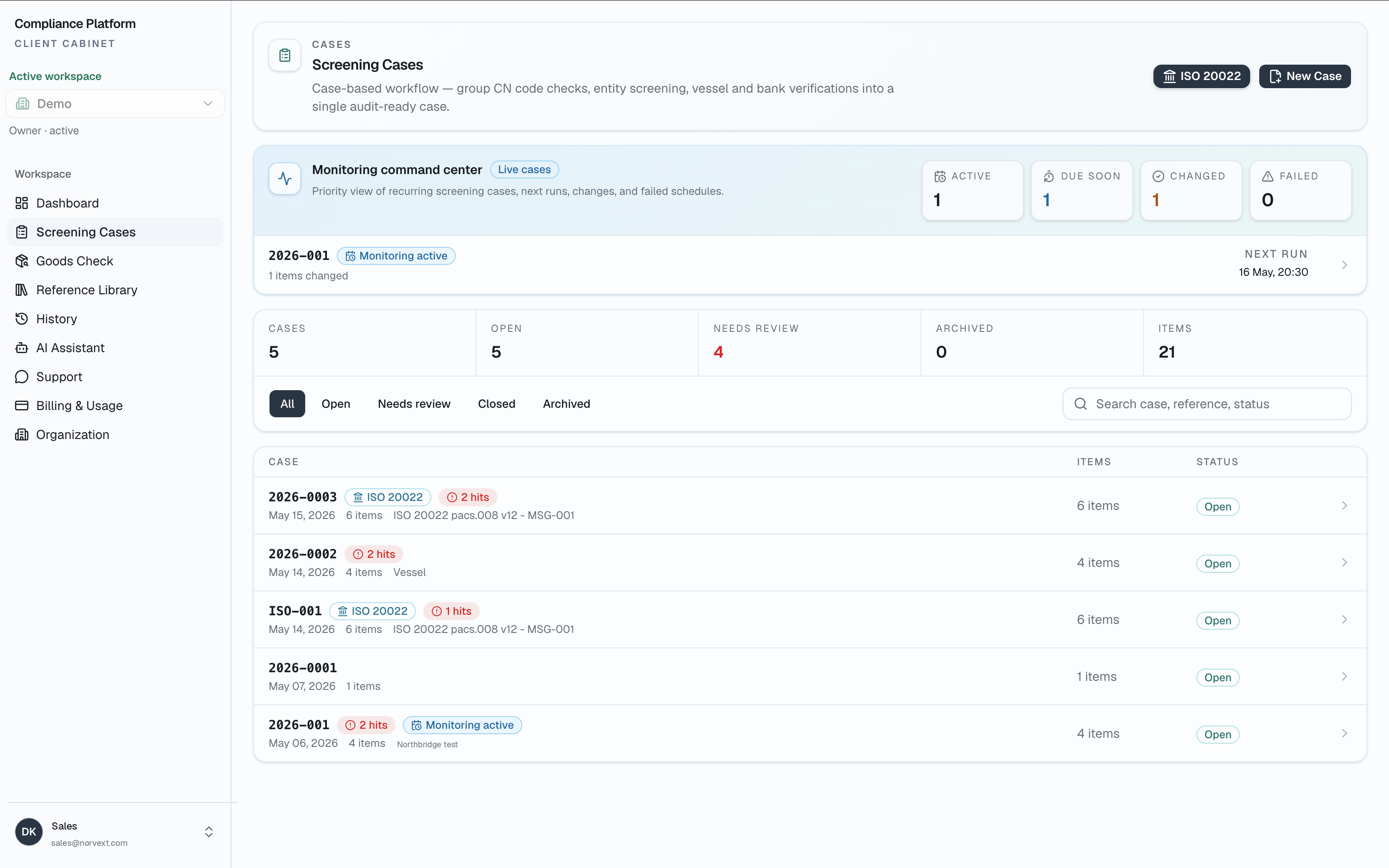
- Persistent workflows join a case. TARIC look-ups, sanctions screenings against people/companies/vessels/aircraft, bank verifications, and ISO 20022 payment cases can travel together. Quick checks can remain transient.
- Lifecycle states drive workflow. Cases move through Open, Closed, and Archived; their items record Pending, Clear, Hit, Review, or Error with timestamps and reviewer context.
- Hits surface inside the case. Red "hits" badges, source-linked entries, reviewer notes — visible in case context, not buried in a separate alerting tool.
- What sets us apart. The large data vendors hand you screening results. Compliance Platform hands you the case those results belong to — the audit-ready artefact.
- Reproducible later. Re-open any case to see exact parameters, hits, sources, and reviewer reasoning as they stood at the time. The audit isn't a separate task — the case is the audit.
ISO 20022
Payment screening, case-ready. Paste pain.001 / pacs.008 XML, review the extracted participants and validation state, then persist the run when a durable case record is required.
The audit isn't a separate task — the case is the audit.
12 · AI Assistant + MCP
Same evidence trail. Now reachable by an agent.
The agent layer is grounded, cited, and recorded — not a parallel AI silo.
- The AI Assistant is source-grounded. It calls platform tools for TARIC, sanctions, entity, payment, and case data, and keeps tool evidence distinct from generated explanation.
- MCP exposes the same workflows to external agents. Any MCP-capable client — Claude, ChatGPT Agents, custom — can call screening as a native tool and receive source-linked evidence.
- Evidence remains attributable. Tool results carry source links and freshness context; generated summaries do not replace the underlying record.
- Persistence is explicit. Agent workflows can create the same Screening Case artefact as the Web UI; one-shot tool calls remain transient until the user chooses to save them.
- Practical use: drafting reviewer notes for ambiguous matches, retrieving past cases involving a country or programme, batch-checking lists of counterparties / vessels / banks, summarising regulation conditions in plain language.
- Compliance buyers in 2026 are right to be AI-skeptical. The platform's agent layer earns trust by being grounded, cited, and recorded — not by claiming "trust us, our AI is different."
Agentic intelligence
AI Assistant
In-cabinet retrieval
MCP Server
External agents
Indexed data
Source-linked evidence
Screening Cases
Same case · same audit
AI trust comes from attributable tool evidence and explicit persistence, not an unsupported automation claim.
13 · Status & CTA
Ready for real compliance workflows.
A complete workspace for teams that need defensible screening without enterprise overhead.
- Access. Request a workspace and start with your first workflow.
- Available today. No six-figure floor, no six-month integration, and no compliance department prerequisite. Built for teams of any size.
- What access includes. Web UI and MCP within plan limits, live source-backed screening, TARIC measures, Screening Cases, and an audit trail. REST API access is an add-on on paid self-service plans and included with Enterprise.
- How we set it up. Tell us about the workflow, expected volume, and users. We configure the right plan, limits, and integration access.
- Defensive transparency. Not affiliated with the European Commission. Does not replace official sources or decisions by competent authorities.
- Get in touch. Email sales@norvext.com
Get in touch
sales@norvext.com
Share the concrete use case and expected volume — we configure workspace access for trade and regulatory checks, sanctions review, report evidence, or API/MCP integration.
14 · Appendix A · Representative sources by layer
150+ official sources. Relevant coverage per workflow.
The anchor source in each screening layer is named below — the backbone, not the full list. The complete, always-current catalogue is browsable online.
| Layer |
Anchor sources |
| Sanctions · 49 | OFAC (SDN + Non-SDN) · EU Consolidated (FSF) + EUR-Lex Russia/Belarus (Reg. 269/2014, 833/2014, 765/2006) · UN Security Council · UK · Switzerland (SECO) · Canada (SEMA) · Australia (DFAT) · Japan (MOF) · Ukraine (NSDC) · Baltic + Poland national lists |
| Export control · 33 | EU Dual-Use (Reg. 2021/821) + Common Military List · US Consolidated Screening List + Commerce Control List · EU/G7 Common High-Priority Items · Japan METI End-User List · UAE control list |
| PEP / EDD · 28 | European Parliament · UK, German, Spanish and Danish parliaments · France HATVP · Baltic + Central-Asia legislatures · role-scoped UK public bodies |
| MDB debarment · 5 | World Bank · EBRD · Asian Development Bank · Inter-American Development Bank · African Development Bank |
| Maritime risk · 8 | Paris, Tokyo, Black Sea, Abuja, Riyadh, Caribbean and Viña del Mar Port State Control (bans + detentions) |
| Regulatory watchlists · 8 | Baltic supervisory, gaming and consumer-protection warning lists |
| Business registers · 8 | Latvia and Estonia enterprise registers · Poland KRS · Hong Kong Companies Registry · Japan NTA · GLEIF LEI |
| Customs + legal reference · 12 | EU TARIC · ECICS chemicals · EUR-Lex · EU Sanctions Map · EU AML high-risk third countries · EU VIES |
Coverage at a glance
151 enabled sources across ten categories. The table names the anchor in each layer; the full catalogue lists every source with its authority, jurisdiction and freshness evidence.
Browse the full catalogue:
compliance-mcp.com/sources
How the sources stay current
Refresh cadence follows each official publisher and is tracked with freshness evidence. A workflow selects the relevant source profile; every returned candidate identifies its source list, programme, and legal reference.
15 · Appendix B · Close-match search algorithms
Six evidence signals. Exact identifiers remain decisive.
Exact-token and identifier paths are evaluated first; fuzzy and phonetic candidates run when needed, or together in deep-search mode. Name scores rank candidates for review.
| # |
Algorithm |
Technology |
What it catches |
| 1 |
Trigram similarity |
pg_trgm · GIN |
Three-letter fragment overlap. Ivanov Ivan ↔ Ivanov Ivan Petrovich. |
| 2 |
Token-sort trigram |
pg_trgm · sorted tokens |
Removes word-order effects. Sirius Trading ↔ Trading House Sirius. |
| 3 |
Double Metaphone |
fuzzystrmatch |
Phonetic equivalence. Ivanov ↔ Ivanoff, Mikhail ↔ Michael. Cyrillic transliterates first. |
| 4 |
Levenshtein |
levenshtein_less_equal() |
Min-edit count for short strings and typos. Ivanov ↔ Ivanoff. |
| 5 |
Exact token |
token table · btree |
Deterministic alias/transliteration lookup. Northbridge Trading Ltd ↔ stored alias. |
| 6 |
Identifier match |
normalized identifiers |
Registration, IMO, BIC/SWIFT, passport, national ID, tax ID. An exact normalized identifier returns 100. |
Score model
Name score: the strongest applicable similarity or token-coverage signal, then entity-type safeguards.
Corroboration: exact DOB adds +10; a matching subject country adds +5.
Low-information caps: common one-token company queries cap at 70; single-token fuzzy/person and rare company containment cap at 84.
Phonetic-only cap: uncorroborated multi-token, company, and vessel phonetic-only candidates cap at 60.
Exact identifier: returns 100 and is exposed separately from name-only evidence.
Full methodology:
compliance-mcp.com/library/learning/entity-screening-algorithms
Score tiers · default threshold 75
The default candidate threshold is 75. A name score — even 100 — ranks a candidate; it does not confirm identity. Exact identifiers are the separate corroborating signal.
16 · Appendix C · VoP — Verification of Payee
EPC-style close-match labels for screening candidates.
Reg. (EU) 2024/886 requires the payer's PSP to offer IBAN/name verification with the payee's PSP. This product function instead classifies the name distance to sanctions candidates; it is not bank account-holder verification.
| Result |
Scenario |
Logic |
Example |
| MTCH |
exact |
equal after normalization |
Jan Kowalski = Jan Kowalski |
| CMTC |
s2a_levenshtein |
edit distance ≤ 2 |
Muller ~ Mueller |
| CMTC |
s2b_transposition |
one adjacent swap |
Smtih ~ Smith |
| CMTC |
s2c_initial |
initial + surname |
J Smith ~ John Smith · natural person only |
| CMTC |
s2d_phonetic |
phonetic equivalence |
Kowalsky ~ Kowalski · natural person only |
| NMTC |
no_match |
no scenario triggered |
ABC Trading vs XYZ Logistics |
| NOAP |
not applicable |
input or candidate name unavailable |
comparison cannot be performed |
Regulated VoP vs screening classifier
Regulated VoP checks the payer-supplied payee name or identifier against the account-holder data held by the payee's PSP.
Screening classifier applies MTCH / CMTC / NMTC / NOAP-style labels to sanctions candidates returned by the platform. It supports review; it does not satisfy PSP VoP by itself.
References: Regulation (EU) 2024/886, Article 5c; EPC VOP Scheme Rulebook v1.1 (effective 20 September 2026).
Full methodology:
compliance-mcp.com/library/learning/entity-screening-algorithms
VoP normalization · 6 steps
1. Lowercase · 2. Nordic expansion (ø→oe, ä→ae, ß→ss) · 3. Unaccent (é→e) · 4. Strip legal suffixes (SIA, LLC, GmbH) · 5. Whitelist [a-z0-9\s] · 6. Collapse whitespace