Getting started
From the first check to a decision your team can explain.
A practical guide to choosing a workflow, running a check, reviewing the evidence, and preserving the result in a case.
How it works
Self-service when possible, managed setup when needed.
The platform supports both flows: users can start without an invitation, while your enterprise administrator can still configure organizations, plans, service access, and API keys manually.
Request access and describe the first workflow.
We confirm the workspace, plan, and limits.
Create an organization workspace when invited.
Run checks, review reports, or connect API/MCP.
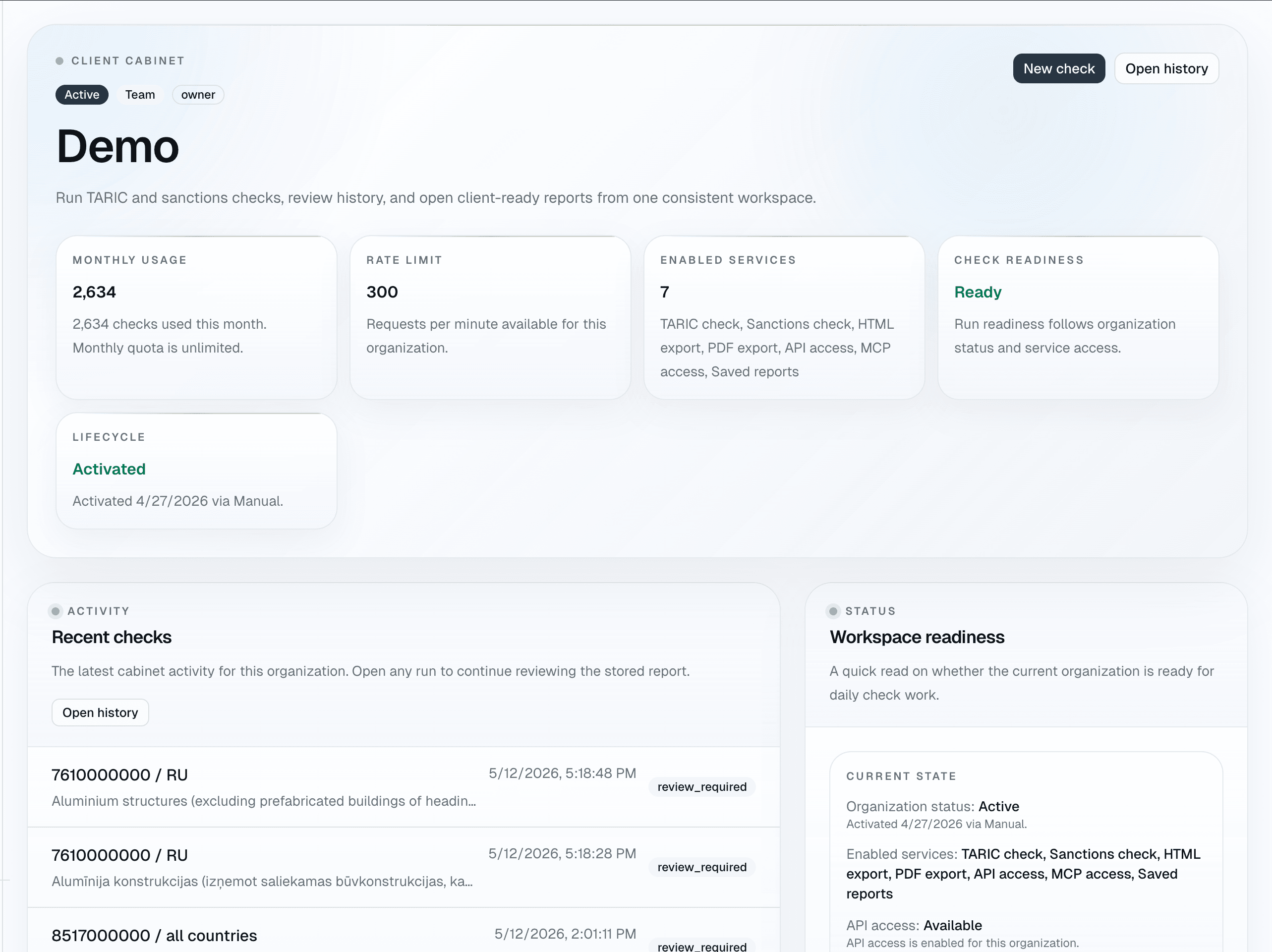
Common workflows
Built around the review questions teams actually ask.
Each workflow stays close to concrete work: a code, payment message, or counterparty, a country context, screening parameters, a legal source, and a report someone can review.
Trade team checking a new CN code
Enter the CN/TARIC code, country context, date, and language. The reviewer gets hierarchy, duties, conditions, footnotes, and source links in one place.
- Input
- CN 8504 40 30 · EU trade review
- Result
- Duty, conditions, footnotes, report
Compliance team screening a legal entity
Enter a company, person, bank, vessel, or aircraft name. The saved case keeps the threshold, list source, partner country, as-of date, and match evidence together.
- Input
- Company name · list source · threshold
- Result
- Match score, aliases, source list, review status
Payment team reviewing an ISO 20022 message
Paste pain.001 or pacs.008 XML. The platform creates a payment case with message integrity, payment chain participants, BIC/GLEIF context, sanctions screening, and report output.
- Input
- pacs.008.001.12 · BICs · participants
- Result
- Payment chain, warnings, participant evidence, PDF report
Internal tool calling the API or MCP
Use scoped organization credentials for repeat goods or entity checks, then keep the report and event history visible for follow-up review.
- Input
- Organization API key · check payload
- Result
- Structured result, case history, and report
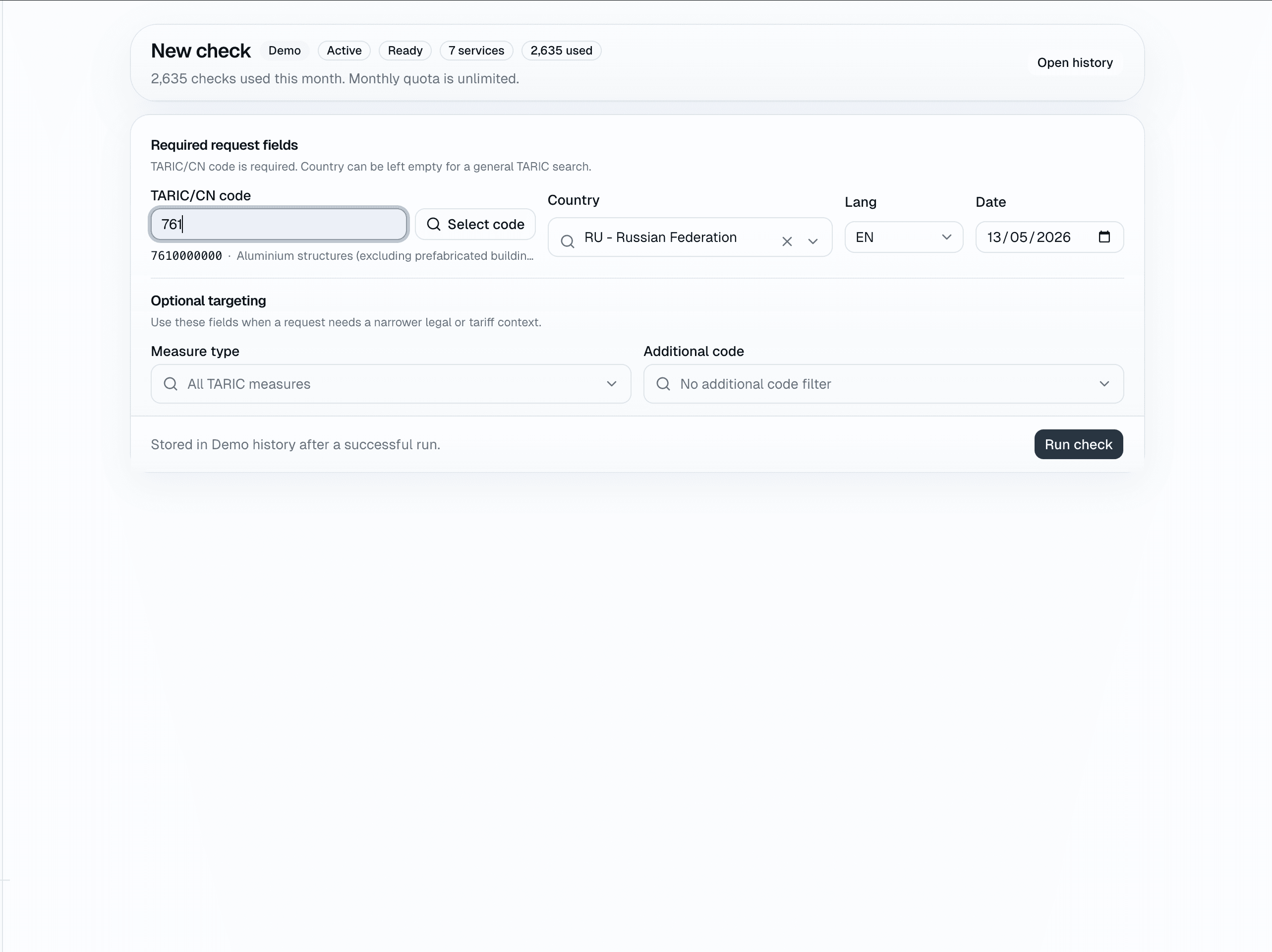
Find tariff hierarchy, measures, duties, footnotes, and legal basis in a structured review flow.
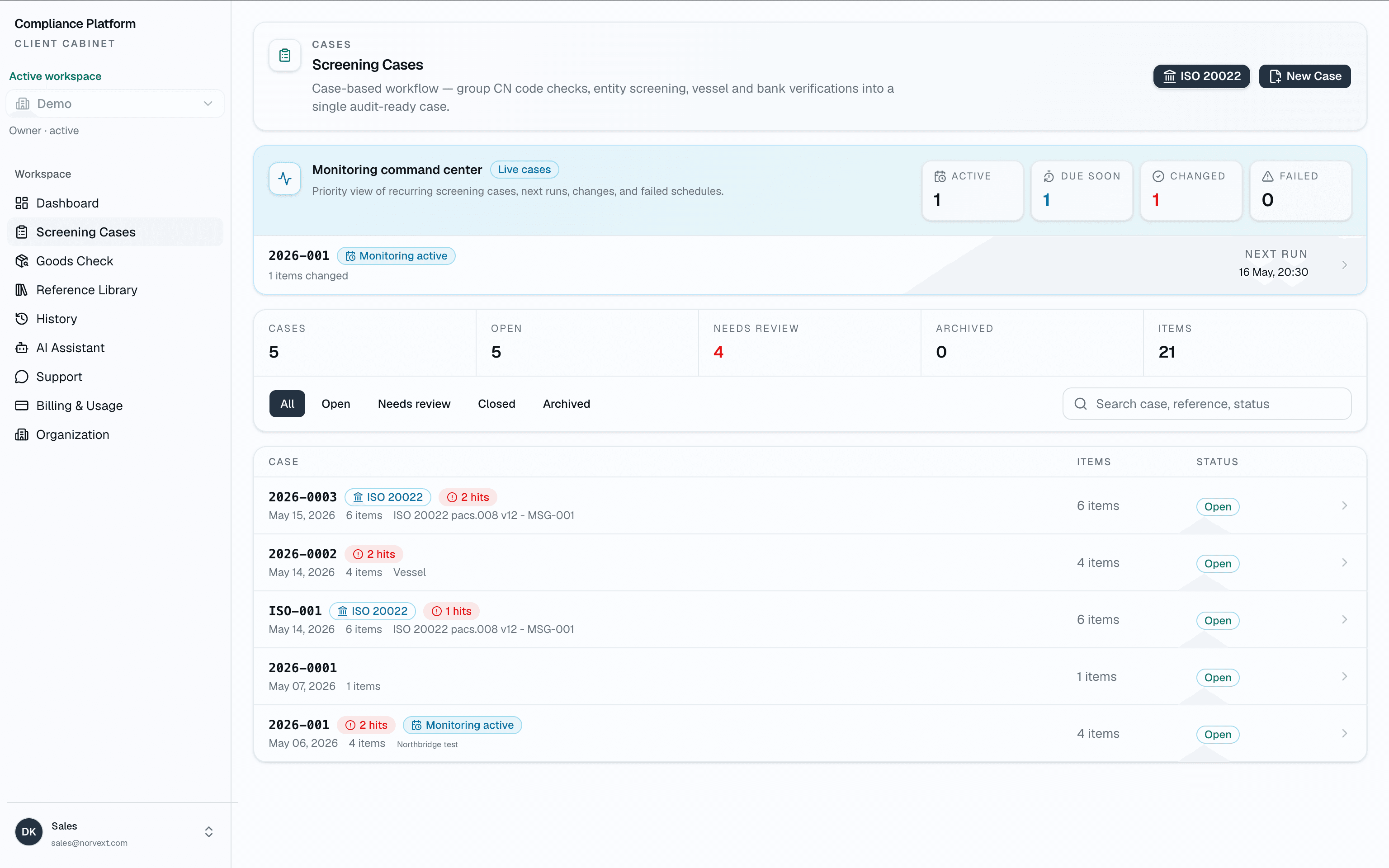
Screening journal
A saved case is more useful than a one-time search.
The platform is designed around reproducible review: what was searched, which source list was used, which date and threshold applied, who ran the check, and who accepted the result.
Save the exact parameters for each goods, payment, or entity check.
Keep matches, aliases, BIC/GLEIF context, source links, and report output next to the case.
Let a reviewer accept or reopen the case instead of losing context in chat or spreadsheets.
Use the journal as a customer-facing evidence trail during disputes or audits.
Review
Decision
Add an item, such as a CN code, entity, vessel, or bank, to run the first check and see a decision here.
ALLOW
No blocking risk, review signal, or evidence gap was detected.
ALLOW WITH EVIDENCE GAP
No blocking risk was found, but evidence is incomplete or degraded.
REVIEW REQUIRED
Human review is required before relying on this result.
The report is evidence support, not a final legal decision. Critical trade and regulatory decisions should be reviewed by qualified customs, legal, or trade compliance professionals and verified against official sources or competent authorities.
Before you request access
Let reviewers inspect the boring important parts.
A serious compliance team wants to see what the report looks like, where the data comes from, how security works, and whether the product is official or independent.
Compliance Platform
Start with one workflow, then expand safely.
Send the concrete use case and expected volume. We will set up access for trade and regulatory checks, ISO 20022 payment screening, sanctions review, report evidence, or API/MCP integration.