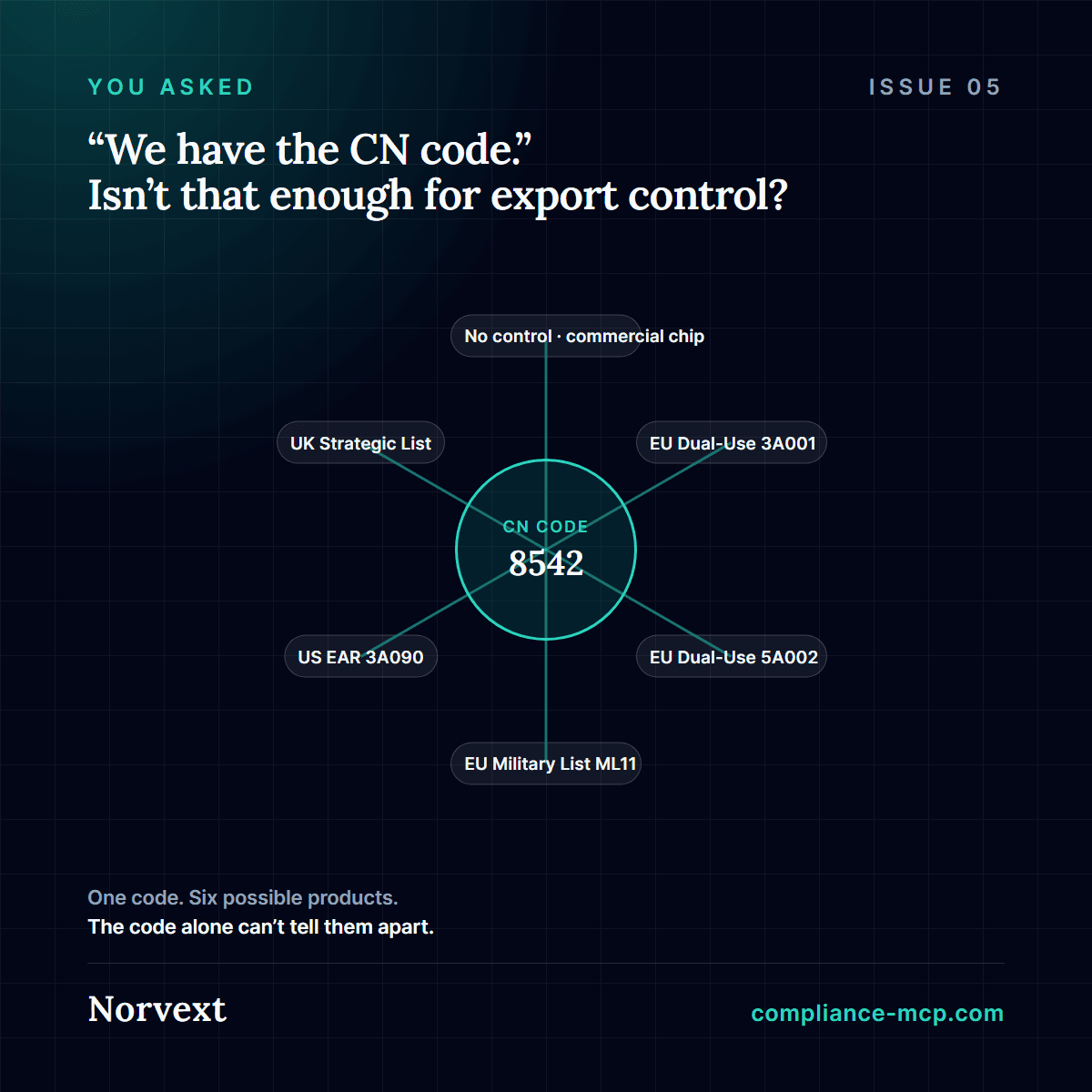
You asked
No — and tested against the platform itself, the gap is bigger than it looks. Searching the export-control catalog by a bare CN code alone typically returns nothing: one code can sit under a heading that covers a dozen real products with completely different control status, and the code carries none of the technical detail that decides which one you have. A short product description or a chemical identifier finds the real candidates — searched that way, the same heading returns matches across several jurisdictions’ control lists at once.
One code, a dozen possible products
Another one that landed almost exactly as a customs desk phrased it. CN 8542 — electronic integrated circuits — covers everything from an ordinary commercial chip with no export-control status at all, to a radiation-hardened part controlled under EU Dual-Use Annex I, to one with cryptography controlled under a different Dual-Use entry, to a military-designed part on the EU Common Military List. The classification depends on characteristics the ten-digit code was never built to carry: radiation hardening, performance grade, encryption, military design, end-use, destination.
This is why a CN code, on its own, is a customs classification and a review signal — never a finished export-control answer. It tells a customs officer what duty applies. It does not tell an export-control analyst what licence, if any, is required.
What actually happens when you search by the code alone
Searching the export-control candidate catalog by the bare code 8542 returns zero results. Not because nothing in the catalog relates to integrated circuits — because a CN code correlates only loosely, if at all, to the specific entries on control lists, which are written around technical parameters, not tariff headings.
Search the same catalog by product description instead — “integrated circuits” — and dozens of real entries come back at once, across the EU Dual-Use list, the UK Strategic Export Control List and the US Commerce Control List, each with its own control-code citation. A chemical identifier works even better: an exact CAS-number match returns candidates from several national control lists simultaneously, each citing the exact regulation.
What to actually send with the code
A short product description, every time a shipment might be electronics, chemicals, optics, aerospace or cryptography — sectors where export-control screening is a legal requirement, not a nice-to-have. The result is still a candidate for analyst review, not a licence decision — every response says so explicitly.
A candidate found is worth infinitely more than a candidate a bare code search never surfaced in the first place.
Reading a CN code correctly for export control
- A CN/TARIC code is a customs classification, not an export-control determination
- Searching a control-list catalog by code alone typically returns nothing — the correlation is too thin
- A short product description or a chemical identifier (CAS, CUS, EC number) finds the real candidates
- A candidate match is a review signal for an analyst, not a final licence answer