You asked
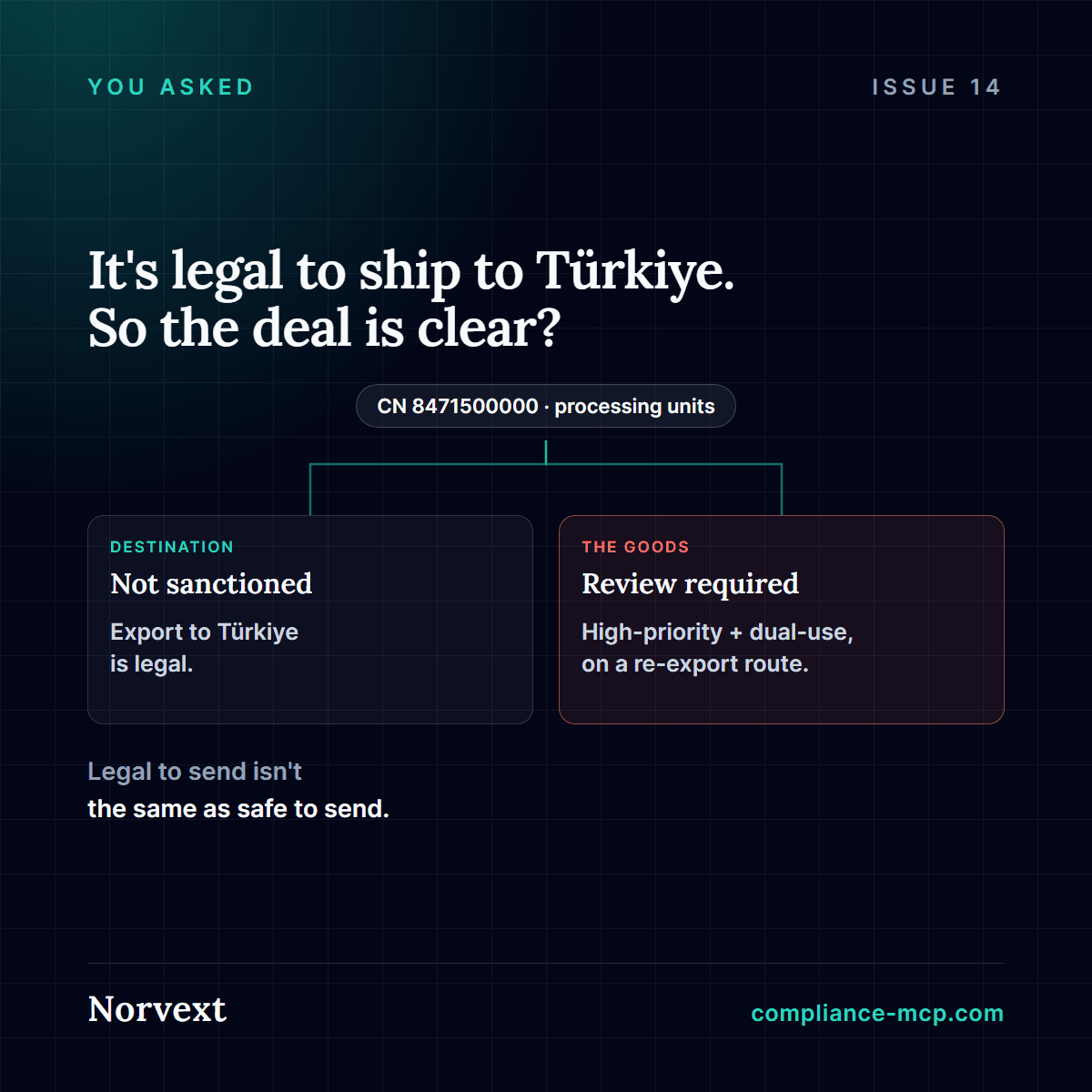
A goods check runs layers that are properties of the item itself — the EU/G7 Common High Priority Items list, dual-use correlation, the EU control regimes — and they fire regardless of where the goods are going. When one of them fires and the destination is a documented Russia/Belarus re-export corridor (Türkiye, the Caucasus, Central Asia, the UAE), the result is review_required with a recommendation to screen the consignee and verify the end-use. The export stays legal. What the result points at is the diversion risk, which a duty-and-measures lookup never shows.
"Not sanctioned" describes the country, not the shipment
A sanctions check on the destination answers one narrow question: is this country under an embargo that bans the trade outright. Türkiye, Kazakhstan, Armenia, Georgia, the UAE and the Central Asian states are not — trade with them is open, and a customs tariff lookup returns duties and measures and nothing alarming.
That says nothing about whether the specific good is one that Russia's defence industry needs and cannot obtain directly. Those two questions run on different data: country risk on one side, the goods' own control status on the other. Clearing the first does not touch the second.
The same good, two destinations, two answers
Take CN 8471500000, computer processing units, shipped to Türkiye. The customs layer is unremarkable. But the good sits on the EU/G7 Common High Priority Items list at Tier 3A, it correlates to dual-use entries across four categories, and Türkiye is a documented re-export corridor — so the result comes back review_required with a recommendation to screen the end-user.
Send the identical code to Russia and the sanctions overlay fires as well: the code is named in four annexes of Regulation 833/2014, including Annex XL, which is the Common High Priority Items list written into the sanctions regulation. Same good, same platform: "screen the end-user" for Türkiye, "restricted" for Russia. Neither answer is "clear".
What "review required" is actually asking for
It is not a block. The workable response is to screen the consignee and any named end-user against the sanctions, PEP and debarment lists, confirm what the goods will actually be used for, and keep that check on file with the shipment. When the buyer is a distributor, that is the point where the diversion risk is highest and the least visible.
The ten corridor destinations the platform escalates on — TR, KZ, AM, AZ, GE, KG, UZ, TJ, TM, AE — are not a blocklist. Export to them is lawful. They are the places where a high-priority good most often changes hands on its way somewhere it should not go, which is exactly why the extra step is worth taking.
Before treating a corridor-country shipment as routine
- A destination with no embargo is not a shipment with no restriction — check the goods separately
- CHPL and dual-use are properties of the good; they fire no matter where it is going
- TR, KZ, AM, AZ, GE, KG, UZ, TJ, TM, AE are documented RU/BY re-export routes — a goods-layer hit plus one of these means screen the end-user
- "Review required" means verify the consignee and the end-use, not "blocked"