You asked
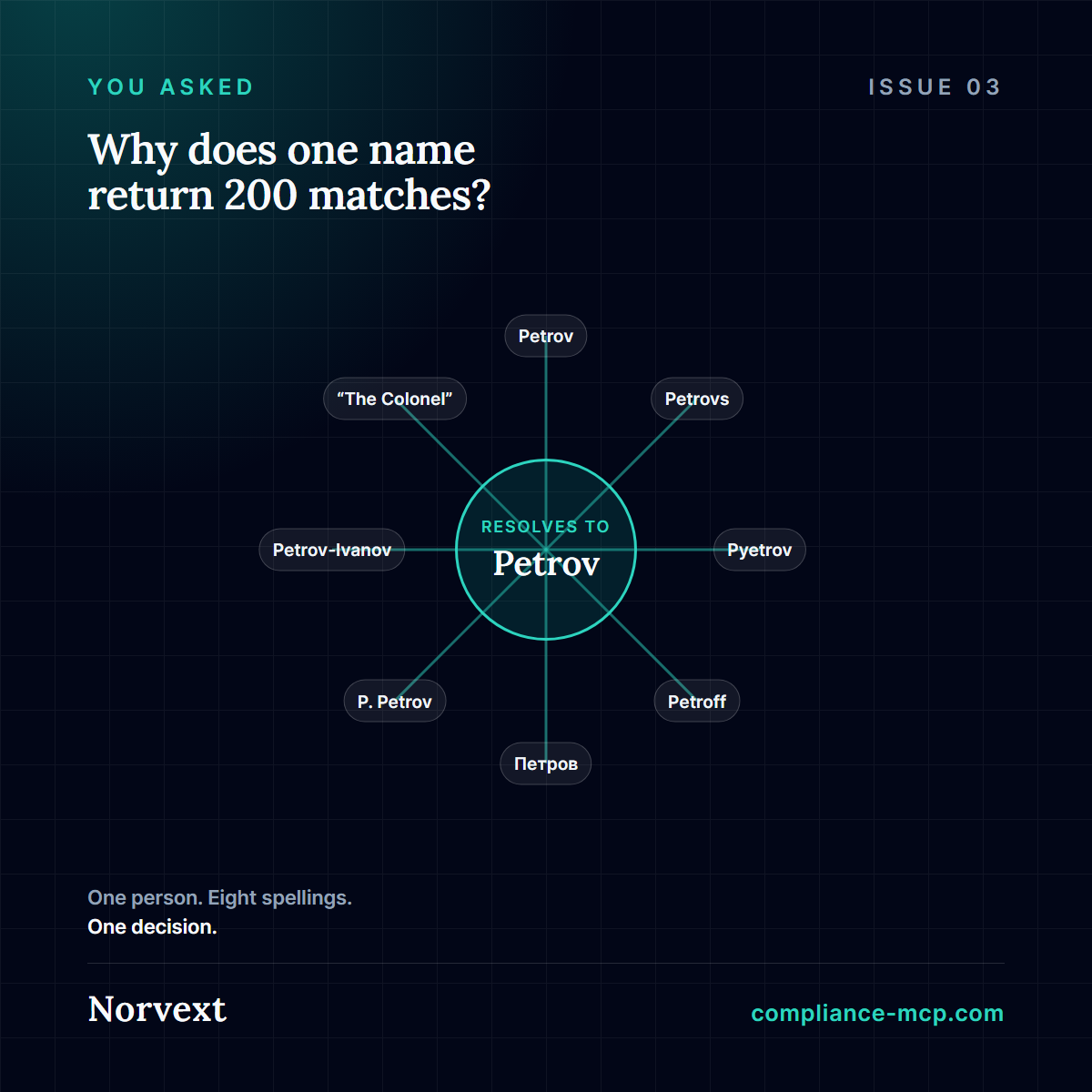
It depends on what the count is actually doing. A sanctioned person can appear in the underlying lists under a dozen spellings — the passport transliteration, the translator's version used when the list was drafted, an older banking spelling, a nickname from a court record. Comparing across all of them is the point, not a bug. The separate risk is a short, common name matching everything that merely sounds similar; a defensible system keeps that case narrow and asks for a second signal, such as a date of birth, before it counts.
One person, a dozen spellings
A sanctioned individual doesn't sit in a list under a single name. Over the years the same person accumulates a passport spelling, a transliteration chosen by whoever drafted the original listing, an older banking spelling carried over from a decade-old wire transfer, a version used in a court filing, sometimes a nickname that made it into a press report and then into someone's internal watchlist. None of these is wrong — they are the same identity described by different sources at different times.
Add the Cyrillic-to-Latin boundary and the count grows again. The same surname can be rendered several different ways depending on which transliteration standard a list, a bank or a journalist happened to use. So screening a name isn't a single lookup — it's a comparison against every written form that identity is known to carry, across both alphabets. Anything less would quietly miss the version that happens not to be on file.
The other failure mode: a name that matches everyone
Cast that net purely by sound and a short, common name turns into noise. A four-letter surname can resemble a dozen unrelated people once you allow for phonetic closeness — most of the resulting matches have nothing to do with the actual person. A list of two hundred candidates doesn't get reviewed line by line; by the fifth screen someone starts clicking 'not a match' without reading, and the one real hit gets buried in the pile they stopped trusting.
So a short, single-word name — especially for an individual — is not allowed to open a fuzzy search on its own. It has to match exactly, or match an official identifier. A phonetic, merely-similar candidate is only surfaced when something else confirms it, such as a matching date of birth. Without that second signal, the phonetic path stays silent.
What a defensible match actually proves
The right result isn't a small number or a large one. It's a result that can explain itself: which spelling matched, against which list, and — for anything short of an exact match — what confirmed it. That explanation is what a reviewer can act on and what an auditor can accept eighteen months later.
A screen that returns a pile of candidates with no reasoning attached isn't a control — it's a queue of unfinished work. The measure of a screening system is not how many names it surfaces, but whether every name it surfaces comes with a reason.
What a defensible name match looks like
- Comparison across known spellings and transliterations, not a single string lookup
- Cyrillic-to-Latin coverage built into the same search, not a separate step
- Short, single-word names require an exact or ID match before fuzzy results open
- Every surfaced match states which list, which spelling, and what confirmed it