You asked
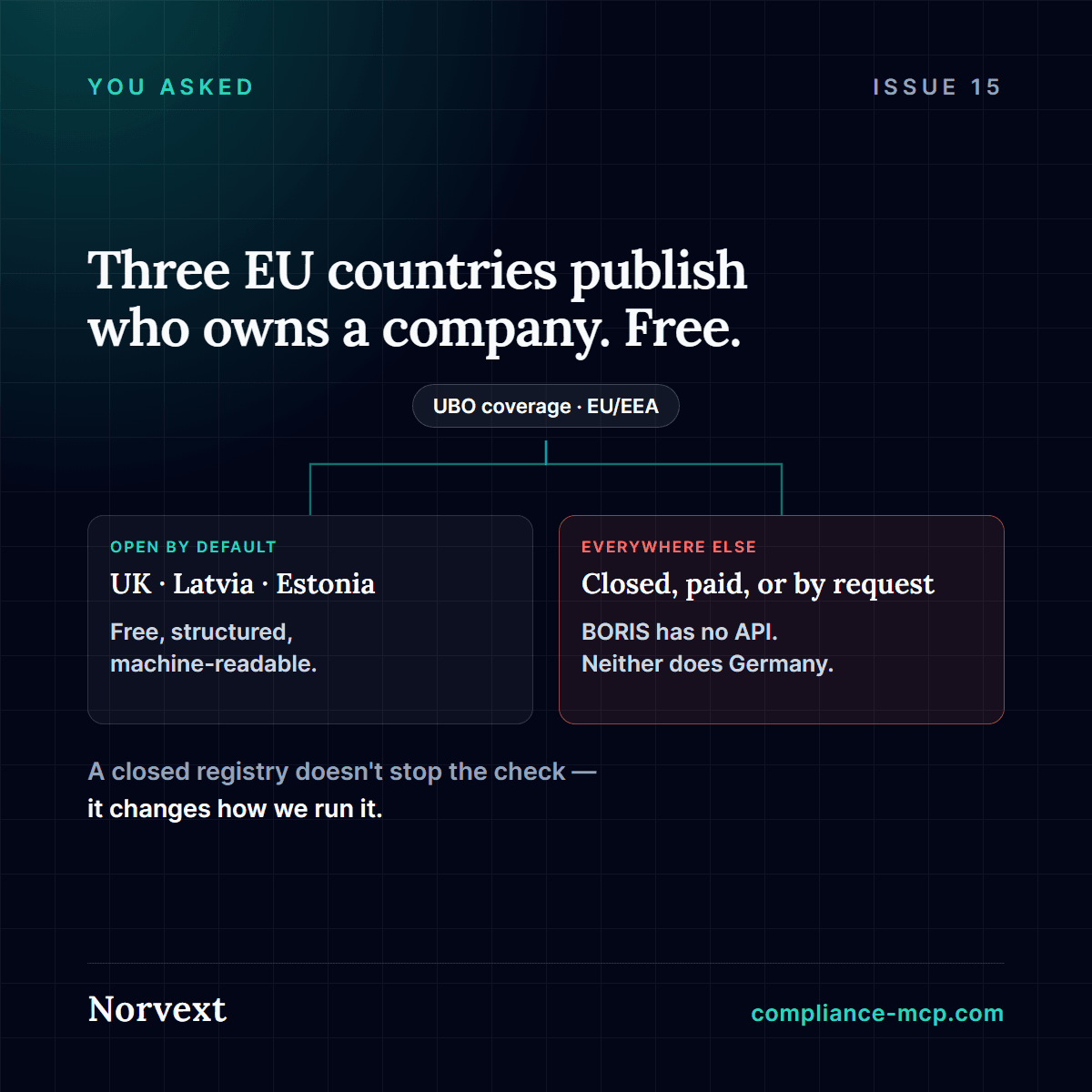
Free, open, machine-readable beneficial ownership in the EU/EEA exists in exactly three places today: the UK, Latvia and Estonia. Everywhere else was closed by the 2022 CJEU ruling, and the promised replacement — a legitimate-interest access route, backed by an EU-wide lookup tool called BORIS — is still a patchwork. As of early 2026, BORIS technically connects 17 of 30 EU/EEA registries, offers no API or bulk access, and most connected countries still review each request case-by-case rather than granting standing access. Where that leaves a jurisdiction closed, we plug in a paid aggregator instead of returning an incomplete check.
Free and open beneficial ownership exists in exactly three places
UK Companies House exposes PSC — people with significant control — through the same open API as its company records. Latvia's UR publishes beneficial owners and shareholders as open data. Estonia's e-Business Register does the same, plus an ownership graph. Everywhere else, the CJEU's 22 November 2022 ruling (Joined Cases C-37/20 and C-601/20, WM and Sovim SA) removed the requirement for public access, and each country replaced it — or didn't — on its own schedule.
A company registry and a beneficial-ownership registry are almost always two separate databases, even within the same country. An open company registry says nothing about whether the owner behind it is open too.
BORIS, the EU's own fix, is a directory — not a database
The Beneficial Ownership Registers Interconnection System was built to solve exactly this: one portal into every national register. As of early 2026, only 17 of the 30 EU/EEA countries have completed the technical connection, and BORIS itself provides no API, no bulk access, and no machine-readable output — it's a manual, one-company-at-a-time search that returns a PDF.
Even where it works, most access is case-by-case. Only France and Spain grant standing access once legitimate interest is proven; the rest — Germany, Belgium, Austria, Denmark and others — review each request against one named company. Germany's own applicants have been waiting for a response since March 2025. From 2026, AMLD6 requires registries to answer within 12 working days — that shortens the wait, not the process behind it.
Where a registry is closed, we don't return an incomplete check — we connect a provider
Germany is the clearest case: there's no free API for the Handelsregister or the Transparenzregister, official or otherwise. A paid aggregator fills the gap instead — OpenRegister's published pricing puts a beneficial-ownership extract at roughly €0.25 per lookup and a company record at €0.10–0.20.
We're not tied to one vendor. When a client's due-diligence flow needs a specific closed jurisdiction — Germany, Poland's CRBR, Lithuania's JANGIS — we can connect a paid provider for that country specifically, priced per lookup, instead of waiting months on a legitimate-interest application.
Before assuming a registry has no answer
- Free, open, machine-readable beneficial ownership in the EU/EEA exists in exactly three places: UK, Latvia, Estonia
- BORIS connects 17 of 30 EU/EEA registries so far — and even connected ones are manual, single-company lookups, not an API
- Only France and Spain grant standing legitimate-interest access; most other EU countries review each request case-by-case
- Where a country's registry is closed or paid, we can connect a specific provider for it rather than leave the check incomplete