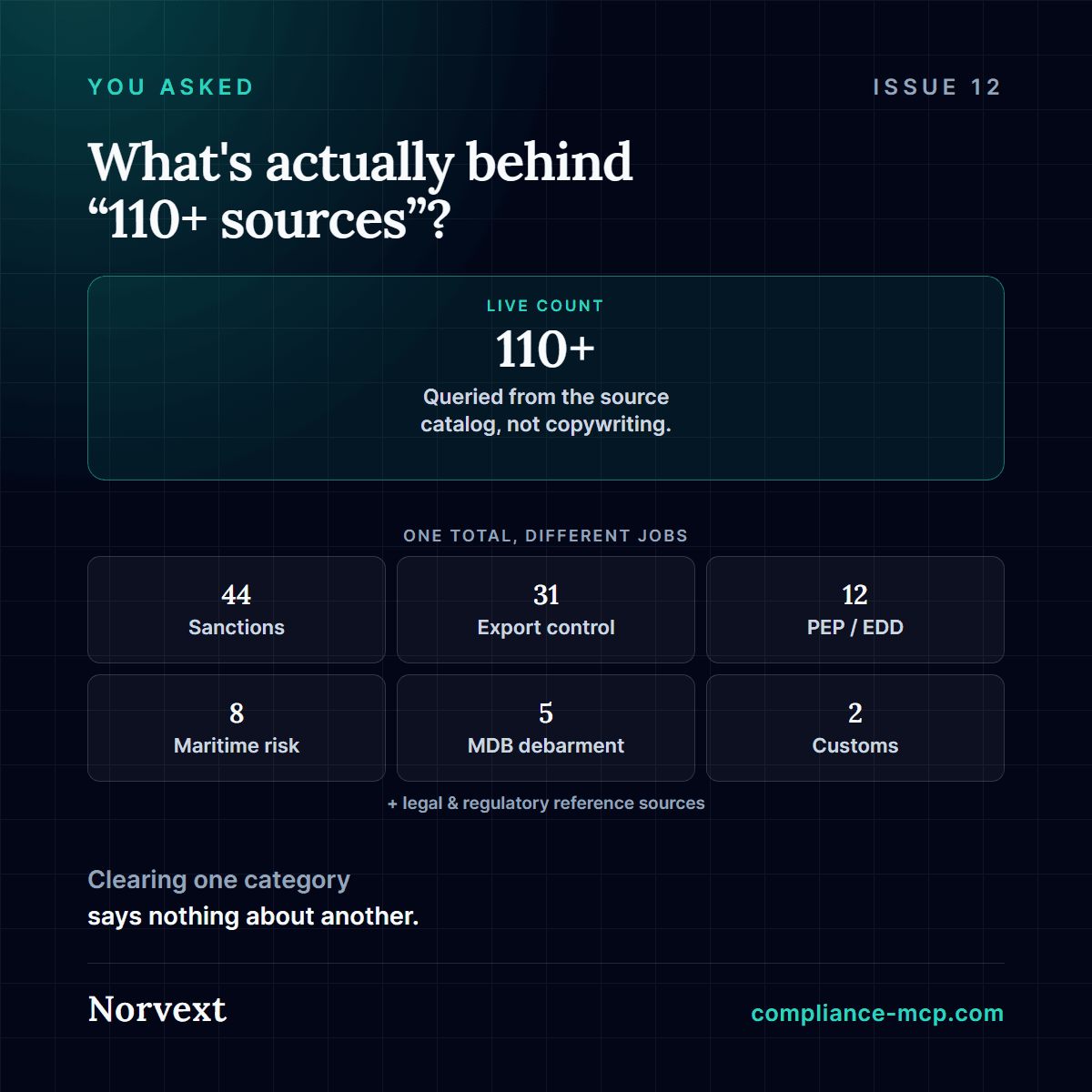
You asked
"150+ sources" on our site isn't a number someone picked — it's the live count of enabled feeds in the source catalog, the same catalog the platform itself queries to run checks. It's stated as a floor ("150+", not a fixed figure) specifically so it doesn't need editing every time a new source gets added — today the live count sits higher. But it's a sum across categories that do genuinely different jobs: sanctions lists, PEP/EDD registers, export-control entity and goods lists, maritime risk sources, multilateral development bank debarment lists, customs reference data, plus legal and regulatory reference sources behind the scenes. A single counterparty-name check never touches the goods or customs sources; a single CN-code lookup never touches the PEP sources. Citing "150+" to describe one specific check overstates what that check actually used.
Where the number actually comes from
"150+" is a live SQL count against the enabled rows of the source catalog — the same table the platform reads from to run checks, not a figure written into marketing copy. It's phrased as a floor on purpose: stating "150+" instead of an exact count means the number doesn't need a copy edit every time a source gets added, re-enabled after a review, or temporarily disabled — it stays true rather than staying current to the day.
That also means any single published count, including the one in this article, is a snapshot. Sources get added, paused for review, or reconnected on their own schedule. The only place a coverage number is always current is the catalog itself, queried live — not this page, not a deck, not a sales conversation.
One number, many different jobs
The categories behind the aggregate answer genuinely different questions: is this person or company sanctioned, is this person politically exposed, is this good subject to export control, is this vessel high-risk, is this counterparty debarred by a multilateral development bank, does this customs reference apply — plus legal and regulatory reference sources that support the others rather than answering a question on their own. A check built for one of those questions structurally cannot draw on sources built for a different one.
Concretely: screening a company name for sanctions runs against the sanctions category. It does not run against maritime-risk or customs sources, even though both live under the same "150+" umbrella. Treating the aggregate as "how many sources backed this result" is the same mistake as conflating WHO and WHAT in a sanctions check, one level up — clearing one category says nothing about how many sources backed the answer to a completely different question.
How to read a coverage number without it misleading you
The honest way to ask the question is category-specific: not "how many sources do you have" but "how many sanctions sources back this screening result" or "how many export-control sources back this goods classification." A screening result that separates its evidence by category — which list, which source, when it was last synced — answers that question directly; a single combined number never can.
That discipline works both ways. A vendor whose only public figure is one unqualified total, with no way to see which category actually backed a specific result, is asking for the same blind trust this article argues against. Ask for the breakdown, not just the headline.
How to read (or challenge) a big coverage number
- "150+" is a live floor from the source catalog — queryable, not chosen by a copywriter, and deliberately imprecise so it doesn't need constant editing
- The total sums categories that answer different questions — sanctions, PEP/EDD, export control, maritime risk, MDB debarment, customs reference, legal/regulatory reference
- A specific check only draws on its own category — a name screening never touches goods or customs sources, and the reverse
- Ask what's enabled for the specific check you need, not the aggregate — and expect the answer to name the category, not just the total